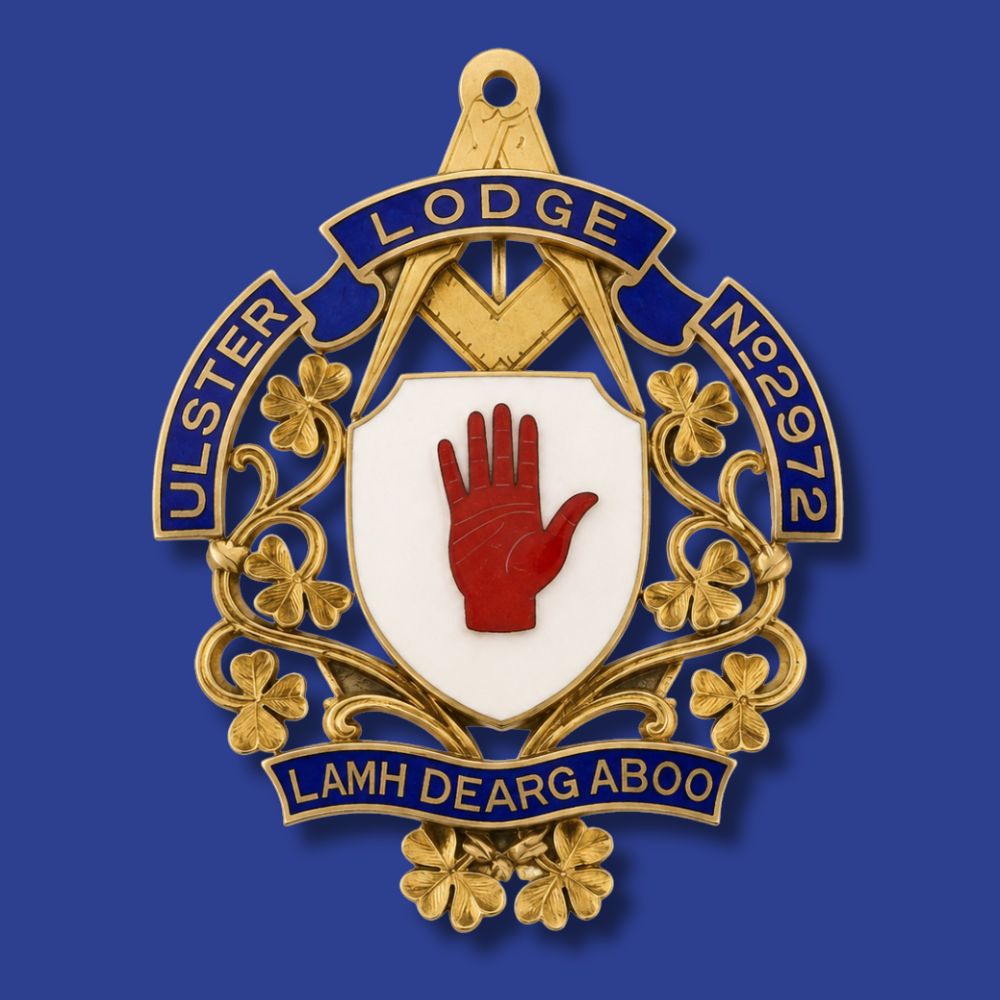
LODGE ARCHIVE · 1903
The men who founded Ulster Lodge
The original register preserves sixteen petitioners at the beginning of Ulster Lodge No. 2972. Later Lodge histories remembered a smaller group. Both records matter.
Sixteen petitioners in the original register
Folio 18 of the surviving membership register begins with a distinct petitioner list. The margin records: “Petitioners; Warrant granted 18th May 1903.” Sixteen men are entered before the ordinary membership register begins.
This gives us a firmer starting point than the later Jubilee booklet. Some handwriting remains difficult, so uncertain readings are shown honestly rather than silently corrected.
Why this changes the page
The 1953 Jubilee Review is invaluable, but it was written fifty years later after many early records had been lost. The register is closer to the founding itself and explicitly labels these sixteen men as petitioners.
Why did the 1953 history name only seven?
The Jubilee booklet’s Past Masters list marks seven names with an asterisk and treats them as founders: A. E. W. MacCamley, J. B. Crowe, T. Dunwoody, Dr H. Knox, S. Crawford Hillis, Rev. Crawford Hillis and R. A. McQuitty.
That list is not necessarily “wrong”. It appears to be doing something different: identifying founders who also appeared in the Lodge’s succession of Masters, or preserving the Lodge’s later memory of its principal founders. It does not reproduce the full petitioner list from the original register.
The contemporary 1903 founder list
A report in the Northern Whig on 14 November 1903, published the day after the Lodge opened, explicitly says ‘The founders are’ and gives a much fuller list. Because this is contemporary evidence, we are using it as the stronger working source while the original Lodge register is checked.
- A. E. W. M’Camley — Worshipful Master
- Samuel McKee Barry — Immediate Past Master
- J. B. Crowe — Senior Warden
- S. Dunwoody — Junior Warden
- Rev. F. Graham — Chaplain
- R. A. M’Quitty — Treasurer
- John Irwin — Secretary
- J. Crawford Hillis — Senior Deacon
- Dr Hugh Knox — Junior Deacon
- R. J. Stevenson — Inner Guard
- H. Hastings Jones — Director of Ceremonies
- Captain Vaughan Jones
- T. M’Cabe
- R. Coulter
- Dr J. S. Crone
- H. M’Carrick
- J. J. Robertson
- T. F. MacGeagh
- Max Clarke, A.R.I.B.A.
- R. J. M’Carthy
- T. Williams — Tyler
The seven founder-Past Masters highlighted in 1953
1903–04
A. E. W. MacCamley
First Worshipful Master. The exact spelling and expansion of his name are still being checked against the original register and contemporary reports.
1905
John B. Crowe
Remembered as the man who suggested an Ulster Lodge during an Ulster Association outing on the Thames.
1906
Thomas Dunwoody
A petitioner who remained central to the Lodge for decades and survived to its Golden Jubilee.
1907
Dr Hugh Knox
Petitioner, early Master and long-serving Treasurer.
1908
S. Crawford Hillis
The name appears in later Lodge records, but work continues to reconcile it with the register’s Samuel Crawford Gillis reading.
1913
Rev. Crawford Hillis
Later Master and long-serving Chaplain. The relationship, if any, between him and S. Crawford Hillis is being checked carefully.
1920
R. A. McQuitty
The register gives Robert Atkinson McQuilty; later Lodge records generally use McQuitty.
The first officers were another overlapping group
Contemporary reports of the consecration list an original officer body which overlaps with the petitioner list but is not identical. It includes names such as John Twining, J. J. Robertson, R. J. McCarthy and T. Williams alongside petitioners such as Crowe, Dunwoody, Knox, MacGeagh, Crone and Stevenson.
That distinction is important. A man could be a petitioner without holding one of the first Lodge offices, while another brother could serve as an officer at the consecration without appearing on the warrant petition as we have transcribed it.
Why some names still look uncertain
The surviving register is handwritten and several entries conflict with printed Masonic reports. M’Camley appears in forms resembling MacCarnley; Samuel Crawford Gillis may correspond to S. Crawford Hillis; Henry Hastings Innes conflicts with a printed H. Hastings Jones; and Isaac Clarke must be checked against the printed Max Clarke, A.R.I.B.A.
We are not going to tidy those problems away. The aim of this archive is to show what the evidence actually says, mark uncertainty clearly and correct the record as better evidence appears.
THE NEXT STAGE
Who were these men?
We are now researching the sixteen petitioners individually through census returns, newspapers, military records, professional directories, other Lodge records and family history sources. The goal is not simply to collect famous names. It is to understand the friendships, professions and Ulster networks that actually created the Lodge.