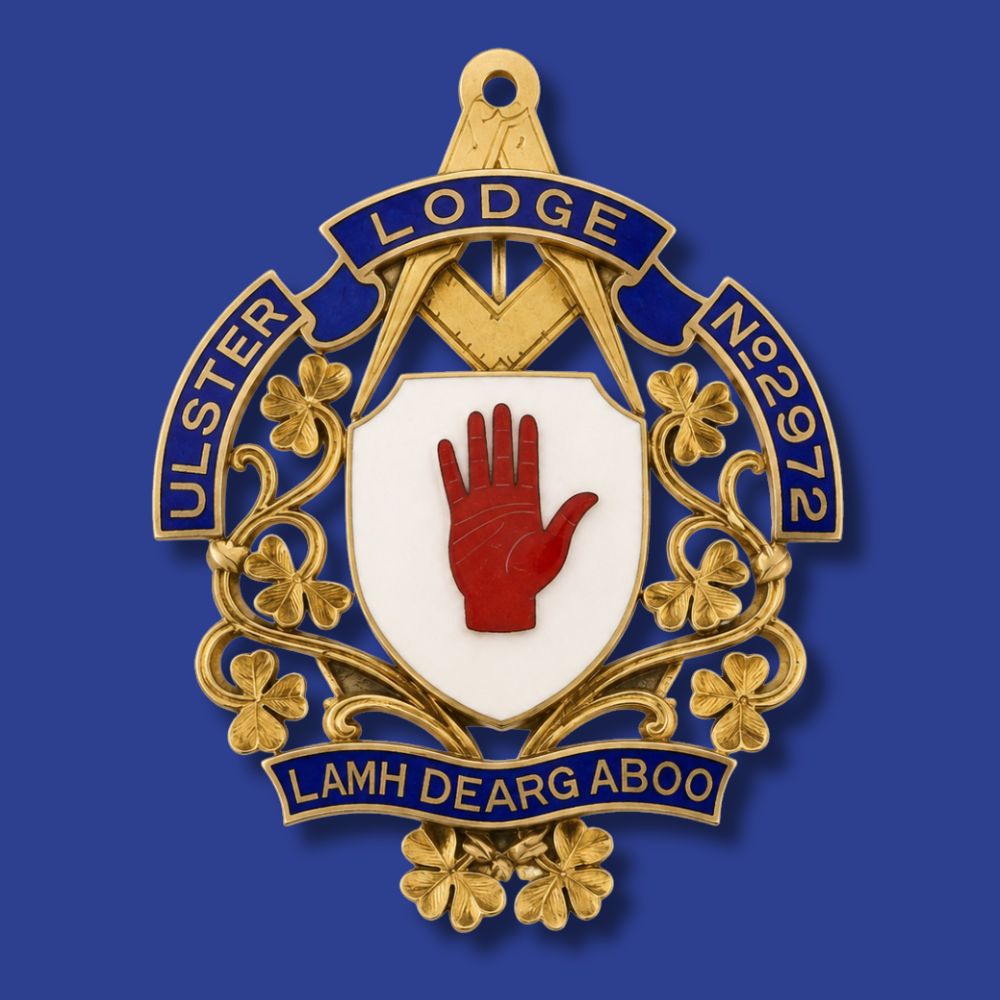
Long before rehearsal nights became another diary entry, Ulster Lodge had its own Lodge of Instruction devoted to teaching the work properly.
The Lodge’s 1953 Jubilee Review gives a brief but revealing account of this quieter part of Lodge life.
Founded early in the Lodge’s history
The Lodge of Instruction was established early in the life of Ulster Lodge on the initiative of W. Bro. Henry Suche, one of the Lodge’s first initiates.
It met weekly for seven months of the year. Its purpose was straightforward: to train brethren taking office, help them learn their duties and rehearse the ceremonies.
That regular practice mattered. The Lodge’s reputation depended not only on who attended its meetings, but on the standard of the work carried out inside them.
Henry Suche and a long tradition of teaching
The Jubilee Review describes Suche as a noted authority on the ritual. He conducted the Lodge of Instruction for more than twenty years.
He was followed by W. Bro. H. L. Spratt, who continued the work for about fifteen years before retiring.
W. Bro. David Torrens, who had served as deputy, then became Preceptor, with W. Bro. J. McKaig as his deputy. When Torrens’s health later began to fail, the work passed to W. Bro. W. P. Wallace, assisted by W. Bro. Howard McCann.
By the time the Jubilee Review appeared in 1953, this represented several generations of brethren passing the Lodge’s ritual and standards from one group of officers to the next.
A reputation noticed by visitors
The booklet makes a point of saying that the Lodge’s interpretation of the ritual and the dignified conduct of its ceremonies had received praise from Grand Officers and visiting brethren.
That praise did not happen by accident. Behind the public installation meetings and formal occasions was the repetitive work of practice: learning words, movement, timing and responsibility.
It is an important part of the Lodge’s history because it shows how standards were maintained. Ulster Lodge was not simply relying on talented individuals. It created a structure in which members taught the next generation.
Part of the Lodge’s inheritance
The names in the 1953 account may belong to another era, but the principle is familiar to any Mason. Good ritual is built through patient rehearsal and brethren giving their time to help others improve.
The Lodge of Instruction was one of the places where Ulster Lodge’s culture was handed on.
Related reading
- Four unusual moments from Ulster Lodge’s first fifty years
- The 1928 Semi-Jubilee and Lord Ampthill’s tribute
- The remarkable men connected with Ulster Lodge by 1953
Source: Ulster Lodge No. 2972, A Jubilee Review, 1953.